Midsommar: Cultivate the Broken Heart
 Why the fuck would anyone join a cult? I spent my childhood haunted by Jim Jones’s power to convince his more than 900 followers to drink the cyanide spiked kool-aid. It’s the moment just before the fateful sips that loop around my thoughts. What are you thinking? What about your sweet little children? How could you be so blind? I open my eyes to mothers killing their babies. I can’t unsee what comes next. I stare at the historical images in disbelief. These people chose willingly.
As I’ve grown older, I’ve come to understand how our hopes can too often lead to nightmares. When our sanity hangs in the balance, we’ll choose most anything to remain attached. When lost and lonely, searching for something to fill our empty hearts, we’ll let nearly anything in. Our futile hunger for connection drives us down the darkest paths

Jonestown: Aftermath
and up the coldest trails. We perish in our attempts; we suffer in the end, ironically, still alone.
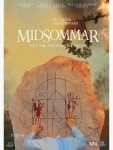
Ari Aster’s Midsommar invites us to see for ourselves how this can happen. We get to tag along with Dani and her boyfriend’s college buddies as they embark with Pelle to his home in Finland. They think it’s a commune, we know it’s a cult. As a matter of fact, we know everything before Dani and her “friends.” We know that she is invited on the trip out of pity; we know that Christian is still with her because she is fragile, having suffered an unspeakable tragedy; we know that Christian’s friends would rather Dani not accompany them; we know that Dani is alone, lonely, and longing to feel loved. But most of all, we know that this journey to Finland will surely not end well.
This is the fun of Midsommar. Instinctively, we know what is going to happen. We always know before Dani, before Christian, before each of them of their fate. What we are  tasked with is a mission; we must find the flaws, the moments that don’t add up, the clues that will surely alert this group of intelligent grad students to their pending peril; we look too closely at the paintings on the walls, at the herbal drinks they are constantly imbibing, at the dances and rituals to call foul on the filmmaker. We want to raise our hands and say, “this is ridiculous! I would have run out of there by now.”
And maybe you would have, but probably not. Because this cult is captivating; this cult is diabolical and passionate. This cult is confident in their ways; this cult is in command of human nature’s trappings and its guests are unprepared for the shocking lengths to which this cult will go to maintain order and honor traditions. And we look on in horror as the rituals intensify, the motives crystallize; we find ourselves entranced, lost in the mass hysteria of the communal experience. Connections are broken and reformed, death is welcomed in a fiery dance, and broken hearts are mended by the screams of those sacrificed to the gods.

Midsommar will captivate you with its beauty as easily as its horrors. And although the audience never quite connects with Aster’s characters, it becomes clear that this is the point, that we are human, trapped alone, each in our own heads. We are only “linked to one another by such slender threads,” we can never truly be connected to anyone. We can only hope to keep our hearts filled with enough love to protect us from ourselves.
Ty Greenwood’s Mother Legs: A Book Review
 Ty Greenwood’s Mother Legs is a vicious, gory excursion into the heart of Anytown, USA, where addiction, poverty, and hopelessness darken the spirit and rot the soul, and where scheming demons lurk in the darkness, driven mad by their loneliness.
Blake is the victim of this drug addicted town, a lost boy in search of his missing mother. Like most parents here, she chose the needle over Blake and his little sister, two more children lost to imaginary highs and desperate lows. Drawn together by a common enemy, Blake and a band of tattered folk join forces to hunt an unspeakable horror. It’s man versus nature, in which nature is nearly man and man has lost his way.
There are monsters and madmen and blood and guts and moments of pure terror. Greenwood’s brush paints nightmares of brutal violence. But set against the madness and mayhem are a group of characters overflowing with love. And when all seems destined to end in a tattered sack of blood and bones, Greenwood proves still that only love can hold us all together.
Mother Legs is a fun and terror filled read. It moves quickly and entertains endlessly. And while he poses big questions and even bigger problems, Greenwood covers them all in gallons of blood and decaying flesh.
Publisher: Hellbound Books
Author: Ty Greenwood
Title: Mother Legs
Published: November, 2018
Flipping Through Fangoria #65 – July ’87
 There are little pieces of movies burrowed into my subconscious; lines and songs from them often burst forth at just the right moments, triggered by a word or situation – Jaws (“We’re gonna need a bigger boat”), Seems Like Old Times (Eat the chicken, Fred) A Star is Born (Admission’s free you pay to get out) And Justice for All (You’re out of order, this whole courtroom is out of order), The Godfather (never cross the family) and Scarface (Say hello to my little friend); Zorro the Gay Blade (You’ve seen me walk before), All that Jazz (I think I’m gonna die), The Jazz Singer (Everywhere around the world, they’re coming to America), and Fletch (Can I borrow your towel, my car just hit a water buffalo). Each one has had some subtle influence on my social and/or political worldview.
But E.T. was most impactful, and in some sense the most damaging. It left me scarred, sobbing and drained. For weeks I couldn’t stop crying. 36 years later, my eyes still well up at the thought of E-L-L-I-O-T’s final goodbye and E.T.’s last words, “I’ll be riiiight here.”
You see mom, I was damaged well before discovering Fangoria. But it was Fango that taught me about the art of making movies and the artists behind them. The writers, always suffering their creation’s adaptations, the producers, pounding the streets to raise money and awareness, the directors, fighting studios, producers, the ratings board, and sometimes their actors to get their visions on screen, and the special effects masters working feverishly, against nearly impossible odds and always limited funds, to bring to life the dark visions of their directors.
Fangoria #65 introduced all of the above. And while flipping through this issue, I am reminded that each faced their personal fears and battled their world’s demons to bring us some of the most memorable films of the 80s.
Hellraiser
Fangoria on Hellraiser
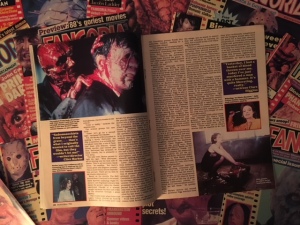
A figure emerges from the shadows of an attic. The attractive woman standing in the middle of the room-already shaken and splattered with blood-starts suddenly, halting her movements with a sharp intake of breath. “Do I disgust you?”…Anatomically he seems perfect…Flayed muscle ripples, bone glistens, viscera steams in the cold air. “Come to daddy,” beckons the skinless man.
Hellraiser is a no-holds barred ghost train ride, a tale of Faustian deals with demons, violent bloody murder, and twisted passion. Hellraiser…is primarily a love story.
Clive Barker on the Dark Side
With Hellraiser, we’re delving into the dark side of desire. This is an extremely black story.
My brother bought me The Great and Secret Show for my birthday in ‘89, but he had no interest in Barker’s books or movies. But 15 years later, I would seize the opportunity to expose him to the masterpiece that is Hellraiser. His wife had recently had an affair with the neighbor from down the street, and Lloyd was struggling with decisions. Stay and work it out for the sake of the kids or get the hell our of there and start anew.
He was spending a lot of time at my house, and one afternoon he was looking for a  diversion. I suggested Hellraiser. “Come on,” I said. “It’s perfect. It’s about the power that the box has over us, and when you open the box, pleasure and pain await,” I said. And just as he agreed, I realized for the first time what Hellraiser was really about.
With some regret, I started the movie. And sure enough, just after Frank appeared dripping wet in the doorway of Julia’s memory, Lloyd turned pale white and demanded I turn it off. He was shaken, and remained that way for sometime after.
An extremely black story indeed.
Clive Barker on the Cenobites
They’re like sadomasochists from beyond the grave.
 The genius of Hellraiser lives within the Cenobites. It is classic misdirection. We remember Pinhead, the image of the articulate demon with a head full of pins, but behind the demon hides its source – the puzzle – a horror too beautiful to show. Yet we continue forever to open the box, repeating the sins of the flesh.
Clive Barker on Bad Movies
I will seek out a bad movie so long as it has an image I’ve never seen before.
The Believers
Mark Frost screenwriter (six million dollar man and hill street blues) on The Believers
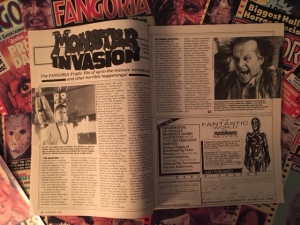
I would call it a classy horror film. It’s a psychological shocker with elements of horror, not an exploitation movie. The Believers is more of a Rosemary’s Baby than a Friday the 13th.
This seems to be a common theme in 1987. Every genre picture stakeholder sought to distance their films from slashers like Friday the 13th. It’s ironic that the movie franchises we love the most have also, some might argue, been most detrimental to the genre. It also why I still love Fangoria; because Fangoria always respected us and the genre.
Mark Frost on Angel Heart comparisons
They’re not really similar. Angel Heart is more of a genre picture. Our film is more rooted in reality.
Covered in Fango 64 and helmed by another titan, Angel Heart might be the better known movie, if only for DeNiro’s turn as the devil and Lisa Bonet’s alluring performance, but The Believers has some memorable moments and the always awesome Martin Sheen.
Groovy Bruce
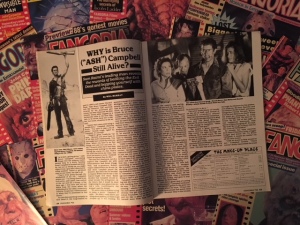
Fangoria on Within the Woods
In Within the Woods, Campbell played the monster. But when the trio decided to expand it to the feature length Evil Dead, Raimi decided that Campbell should instead become the protagonist, on theory that it would be more frightening if a man played the victims role…
Sometimes the simplest choices lead to groundbreaking solutions.
Bruce Campbell on Evil Dead
We were a bunch of idiots trying to make a movie. We didn’t really know anything about padding, so I kind of got scraped up. 
I love this quote. Sam Raimi as idiot? There is something comforting here for a kid reading Fangoria. Raimi was not yet legend, but he would be soon enough; and even he started as idiot.
Bruce Campbell on Ash
I think audiences feel more for the character if they see the guy being knocked around. I’d like to see Jack Nicholson fall on his butt a couple times. I’d go, ‘Gee, he’s working!’ 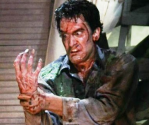
In the first one, up until about halfway through, its very difficult for me to watch it in the theater. Audiences are really abusive because Ash is so dumb.
Howard Berger (a member of Mark Shostram’s FX crew) on Bruce Campbell
Bruce got really, really into it. He eats this stuff up. He bit through the denture for his possession makeup. He went “Rarrrh!” and the denture broke in half, and those things don’t break.
And the legend of the chin was born.
Charles L Grant
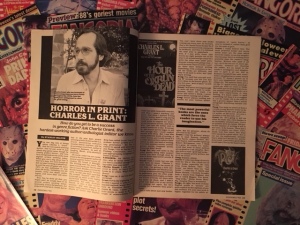
Writer’s write…and write…even when the words won’t come out right. And it was, of course, Fangoria that enlightened this then 15 year old. As a kid, I thought the writer lucky; they get to be home and do whatever they want. They don’t. They sit alone in solitary places and write, for hours upon hours, sometimes dribbling just a few usable sentences or phrases onto the page.
Charles Grant on Why He Writes
I write because I have to write. I can’t go three days without writing something…even a sentence or two.
Writing is an obligation, like breathing. Some might even call it an affliction. But I still want it, to be a writer, but the writing…oh the agony. And instead I watch horror movies.
Charles Grant on the Effects of Television
But as Ramsey Campbell has said, everybody’s imagination is under attack because TV does not permit us to have any imagination.
Thirty-one years later and we are still terrified for our children’s imaginations. Lost inside their phones, elevating YouTuber’s to rock-star status, our kids are growing up on snippets of food challenges and slime recipes delivered by annoying kids with little talent other than acquiring likes. Our kids are isolated from themselves, their thoughts and reflections subdued by their need to swipe to the next. What will become of our children?
Charles Grant on Clive Barker
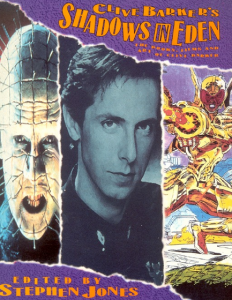 With Books of Blood, Hellraiser and Weaveworld, Clive was at the forefront of the British Horror scene in 1987. So it was only natural that Charles Grant would have something to say. After rereading this article so many years later, it seems Mr. Grant was toeing the line between jealous peer and concerned elder statesman.
Clive Barker is an incredibly talented man…His particular manner of writing is not to my taste, to be honest. There are a lot of no talents out there. Clive, thank God, has talent…I just wish a good editor would take Clive by the hand to help him polish a little of the rough spots.
And he is doing so much. I really am afraid that [he] will burn himself out in less than five years if he doesn’t make up his mind what he wants to do.
His worry that Barker was indulging in too many creative outlets – novels, movies, plays, short stories – seems trite and petty. In hindsight, however, one might argue now that Grant was right. Barker did go through a difficult period in the late 90s and nearly died after a standard procedure led to a dire infection.
Charles Grant on Advice to Young Writers
Read! Watch less TV! Exercise the imagination! Learn to use the damn language. Stay away from manuals of style and creative writing classes. They don’t do a damn thing for you.
The Lost Boys
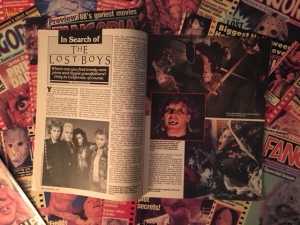
I loved The Lost Boys. It was slick, violent, and bloody. The music was awesome and Jamie Gertz was hot. And in the end, the nerds destroy the bullies and save the girl.
Joel Schumacher on Vampires
Vampires are sexy, as opposed to other great monsters. They’re beautifully dressed, they come into your bedroom. I actually think that in victorian times vampires were created so people could express oral sex…they dreamed of old men sucking the life out of them and of themselves being totally under their spell that they were unable to resist.
Everyone was sexy; the kids oozed sexuality, which accentuated the innocence of the Corey’s while setting up the rip-roaring finale.
Joel Schumacher on Directing The Lost Boys
This has been the hardest job I’ve had in my life…I think sometimes, now that we’re finally finishing the movie, that if I had known at the start how hard this was going to be, I wouldn’t have done it.
Imagine if we knew how hard the capturing of our dreams to be. Would we ever embark on the journey?
31 years later, The Lost Boys foreshadowed the nerdist revolution of the 2000s. While comic book heroes rule the box office, the nerds rule the world.
Thanks for reading. Stay tuned for Flipping through Fango #67 (because I guess I didn’t have enough money to buy #66).
Flipping Through Fangoria #64 – June ’87
Looking back through the pages of my story, I can clearly see a moment of convergence, when all that I was would cease and all that I would become was born. The summer of ’87 presented me with a great challenge, a challenge I was alone to face. Luckily, I now had Fangoria, and #64 introduced me to a slew of new friends – Clive Barker, HP Lovecraft, John Skipp and Craig Spector, Stuart Gordon, David Cronenberg, Frank Darabont, Tom Savini, Howard Berger, and John Beuchler – and a few new enemies – the MPAA and the PMRC.
Flipping through Fangoria #64 begins with Tony Timpone’s second elegy as new editor in chief.
ELEGY
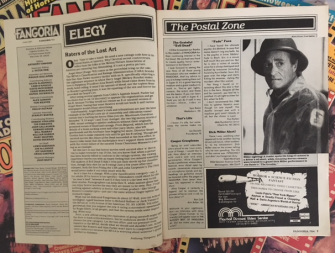
Remember that NC17 rating? Fango editor Tony Timpone took on the stodgy MPAA back in ’87 by documenting the soul sucking process our great horror makers had to endure before the Classification and Ratings Administration. Angel Heart, Toxic Avenger, From 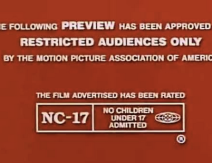 Beyond, and Evil Dead II were all victimized by Jack Valenti’s censorship board. Check out the closing paragraph from Timpone’s Elegy:
Sure, a new official rating might open the door to hack schlockmeisters, but let audiences decide if anyone abuses the new category. Let the box office, and not pressure from fanatics or the MPAA, decide what we should and shouldn’t see. At least talents like Romero and Alan Parker won’t have to compromise their artistic endeavors because the MPAA is worrying about someone’s grandmother in Alabama.
The Postal Zone
Before Twitter, we used to write letters to the editor of our favorite publications. And in June of ‘87, both Sam Raimi and Frank Darabont had their letters published in Fango. Raimi’s letter is a thank you to the fans of Evil Dead II along with some simple advice:
…keep cranking [movies] out in Super-8. It’s a great learning medium and a great medium to work in. You’ve got lights, camera, the actors and those are the basics. If you can learn how to do it well in Super-8, I think you can do it well in any format…
Darabont’s letter takes aim at comments Wes Craven made regarding rewrites to A Nightmare on Elm Street 3. Considering Elm Street 3 was his first credited screenplay, this letter seems a bold move on Darabont’s part. Though he would go on to prove himself quite worthy with legendary King adaptations including Shawshank Redemption, The Green Mile, and The Mist.
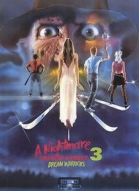 With all do respect to Wes Craven, I must take exception to his comments about the Nightmare 3 rewrite (issue 62). If it were true that all Chuck Russell and I did was “change a lot of names,” the Writers Guild arbitration would never have awarded us screen credit…It would never occur to me to belittle Wes Craven or Bruce Wagner’s contribution to Nightmare 3, which are inarguably substantial. I wish Mr. Craven would afford Chuck and me the same courtesy, even if he is feuding with New Line.
I saw it at The Falls with my best friend David just before my 15th birthday. David swore he wasn’t scared, even after missing 20 minutes with a “stomach ache.” On the way home, he confided that he wasn’t sure if he needed to stand over the toilet or sit on it.
Skipp and Spector
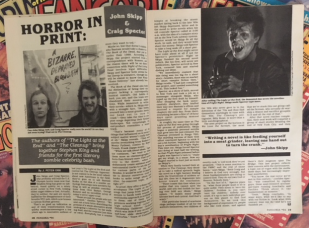
I read all of the Dark Forces books in middle school, but Skipp and Spector’s books were my first foray into adult horror fiction. A Light at the End and The Cleanup made an impression on me, and the socio-political motivations behind The Scream further focused my attention on the role of censorship in our “free” society.
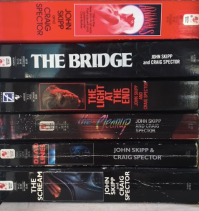 Skipp and Spector on The Cleanup
There comes a time when you realize that you cannot save the world and you feel foolish for having ever held any ideals”
Skipp and Spector On We Love the Scream
On the face of it, what *those people want to do is quite noble: they mean to save the children. Problem is, you can’t save the children, nobody ever could. It’s up to each individual person on this planet to find God themselves. So we took this background of repression vs. people who like rock music, and against that we stuck this one group called The Scream, who actually do worship a demon and sacrifice groupies to…
*Those people are the The Parents Music Resource Center (PMRC), an American committee formed in 1985 with the stated goal of increasing parental control over the access of children to music deemed to have violent, drug-related or sexual themes via labeling albums with Parental Advisory stickers. In 1985, they made a list of “the filthy fifteen” and included songs from Def Leppard, Prince, Twisted Sister, Madonna, and AC/DC.
Skipp and Spector on terror
You know, the real terror we’ve met in this century was committed by regular guys, these anal-retentive accountant-types running Auschwitz and Dachau. Think about it, the businessman as monster.
Creepshow 2
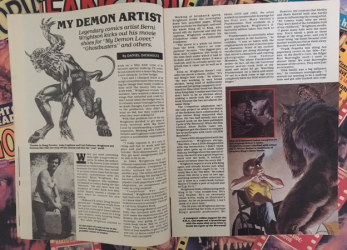
Creepshow 2 was a forgettable movie, but Bernie Wrightson’s comments in Fangoria #64 were blunt and honest. In today’s climate, Bernie might have been crucified for saying these things. But, alas, the world was different when I was 15.
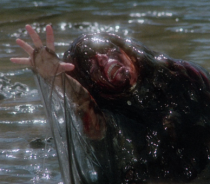 Bernie Wrightson on King’s Creepshow 2
It’s not King’s best work. He was working in very broad strokes, being kind of deliberately crude and just going completely overboard for the comic book feel. Maybe what King didn’t realize was that you don’t have to be so obvious about making a movie look like a comic book because the two are almost the same thing.
Bernie Wrightson on EC Comics influence
EC Comics really blew me away. They were kind of the forbidden fruit of my childhood…You’d sneak a peak at these things at the drug store, and you’d never bring them home because your mother would just throw them away.
Bernie Wrightson on Dick Smith
 I started out wanting to be a make-up man and got side-tracked into comics. I remember Smith’s TV work on Way Out..it was…the first instance where I associated a person’s name with his work…I would wait for his name to come up in the end credits.
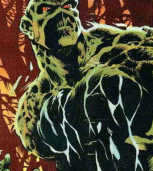
Bernie Wrightson on the Swamp Thing Movie
For about the first 15-20 minutes, they really had something going. Up until the point that you actually see the monster, it was a pretty good movie…As soon as the Swamp Thing appeared, Wes Craven decided it was time for a campy movie…the whole thing became very embarrassing for me.
Tom Savini was my Dick Smith. I studied everything he did and said. KNB FX and Stan Winston would join Savini soon after, especially after Winston’s Pumpkinhead was released.
Evil Dead II – Sam Raimi Interview
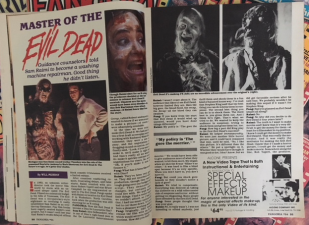
Sam Raimi’s unique vision and willingness to experiment turned my attention to the role of director. I started to understand the artistry in their productions and began searching for unique voices. I would find one such unique voice in Fangoria #65, but that is a story for the next Flipping Through Fangoria.
Sam Raimi On Stephen King
I’ve read that Stephen King said the best thing you can do is keep them in suspense. 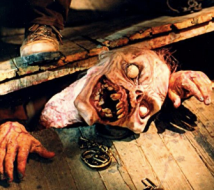 The second best thing you can do is shock them. The third best is you gross them out. And I think he is right. That is what we tried to do…[King] helped immeasurably. We were just another little horror picture, and it could have remained that way, until he said, “No, I like this picture. It’s different than the others.
Sam Raimi On Making Evil Dead II
“I knew I could get money to make Evil Dead II. That was really the motivator. And it was really the motivator for making the first evil dead. I knew that if i made a horror picture, i could get the money and make a movie.”
Sam Raimi On Future Projects
I have a commitment to write two scripts with Joel and Ethan Coen. One’s called the Hudsucker Proxy…it’s a big business 1950s comedy and the best script I’ve ever had the opportunity to work on.
From Beyond
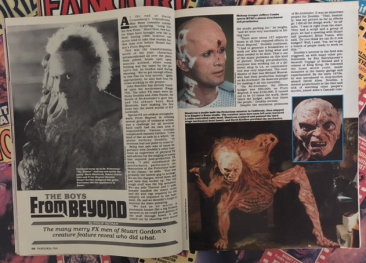
At the end of David Cronenberg’s Videodrome, Max Renn commits suicide while declaring, “long live the New Flesh.” Since then, few films have brought new life to the flesh. During 1986, however, one movie tried to take that maxim further than ever before: Stuart Gordon’s From Beyond.
Cronenberg had already created Scanners, Videodrome, The Dead Zone and The Fly by this time, but he was new to me and I had a lot of free time to get to know him. Stuart Gordon, on the other hand, was following up Re-Animator with another Lovecraft adaptation, From Beyond; and Fango brought it to our attention with images only Philip Nutman could conjure.
 Stuart Gordon on From Beyond
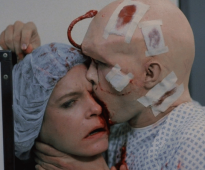
This was the transformation movie of the year: characters metamorphosed all over the place, flesh peeled, heads split open, muscles writhed, slime oozed.“We’ve got enough effects on this film for four movies.”
With references to Re-Animator, struggles with the MPAA, ballooning special effects budgets, and comparisons to the body horror that made Cronenberg a horror household name, I was eager to see it. And it left its mark on me. I am still fascinated by the science of our “third eye” and the unseen horrors that surround us all.
Thanks for reading. And stay tuned for Flipping Through Fangoria #65.
47 Meters Down: A Gateway Shark Movie
My youngest daughter is dipping her toes into horror movies. During the past 3 months, she has watched the first 2 episodes of Stranger Things, begged to re-watch Kong: Skull Island, dragged us to see The Rock in Rampage, and made it through all 3+ hours of Peter Jackson’s King Kong. Last week, she put a whole foot in the water and made it to the 54th minute of Andy Muschietti’s IT (yikes).

And though I have told her numerous times that seeing JAWS scared me away from the ocean until I was a senior in high school, this morning she assured me that she was ready. But it’s summer in Miami and the beach is in our plans, so I selfishly suggested 47 Meters Down or Deep Blue Sea. She took the bait and picked Johannes Robert’s 47 Meters Down.
Kate (Mandy Moore) heads down to Mexico with her sister Lisa (Claire Holt) to prove to her ex that she is not the boring girl he thinks she is. The pair quickly meet two handsome locals and, in spite of the scruffy captain (the awesome Matthew Modine) and his rusty boat, are suddenly braving unknown waters to cage dive with great whites.

But the winch fails and the cage plummets to the bottom of the ocean, 47 meters down. Trapped beneath circling sharks with a dwindling supply of oxygen, the girls are forced to make quick decisions. And though death is imminent, Roberts keeps things fairly light and hopeful without sacrificing intensity.
For an 8-year-old, 47 Meters Down is the perfect gateway to the man eating shark genre. It moves briskly, limits on screen gore, presents strong, brave girls, and captures the awe-inspiring power of the great white shark. And though I am excited to watch JAWS with Evi, I think Deep Blue Sea might buy us some more beach time, at least for one more summer.
Flipping Through Fangoria #63 – May ’87
We grew up on Fangoria. We celebrated the FX wizardry plastered across its pages. We  rented scores of low budget, poorly executed horror movies on the promise of creative slaughter and killer monsters. We discovered up and coming directors making super-cool movies. We fantasized about our own splatter fests documented in Fangoria’s pages. But most importantly, our thirst for the darker side of film was quenched every month by “Horror’s #1 Magazine.”
Flipping through Fangoria is kind of a thank you letter to the magazine, a thanks for slashing a path through the chaos of childhood. And it will be a celebration of the rebirth of Fangoria, back from the dead and ready to spew forth bloody pages once again.
Flipping through the pages of Fangoria #63, I find an article on A Nightmare on Elm Street 3.
A Nightmare on Elm Street 3: Dream Warriors

Heather Langenkamp On Life after Elm Street
With Nightmare such a huge hit, it is hard to fault her for worrying about stardom’s effects on her life. She saw big things ahead, and clearly believed in Dream Warriors.
After I did the first film, I tried to remain pretty anonymous when I went back to school. I cut my hair real short and started wearing glasses. After I did that  film, I found that people seemed to have different motives for being around me. There are people in my life right now that who are keeping extra special contact with me because I’ve done A Nightmare on Elm Street and because I’m an actress. I’m sure that scene is going to get even more intense when Dream Warriors comes out and that really bothers me…I knew if I was going to be an actress and, eventually a good one, I would come up against hangers on at some point.
Heather Langenkamp On Chuck Russell vs Wes Craven
They are definitely different in their approaches to making Nightmare films. Wes, on the  first film, would just sort of sit in the background. He would watch you go through your paces and then step in and fine tune your reactions and your emotions. He was the kind of director who would just let you go to extremes and use your reactions.
Chuck on the other hand has really strong ideas about what he is looking for to begin with. We know even before we rehearse a scene what he wants and what we should deliver.
Both ways of directing have their advantages and disadvantages as far as I’m concerned. Working with Wes was a little looser and freer experience. With Chuck, the whole film making process has been a bit more narrowed down and precise.
Chuck Russell’s Filmography Highlights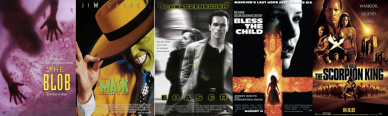
It’s easy now to think these comments slanted critical of Chuck Russell’s direction. Reviewing the highlights of Russell’s career make it even easier, I suppose.
Angel Heart

Alan Parker On Angel Heart
The director of Midnight Express, Fame, Shoot the Moon, and The Wall graces the pages of Fangoria. But with so much respect for us and for the genre. His sense of confidence in his craft was apparent, and Angel Heart left a lasting impression.
I’ve never attempted the classic kind of thriller before, nor anything to do with the supernatural. I read Falling Angel when it was first published in 1978 and rather liked it. Robert Redford snapped it up, but couldn’t see himself playing Harry Angel.

Angel Heart is a pretty tough story. [It] is my most powerful film since Midnight Express. There’s death everywhere these days, and Angel Heart shows how easy it is for people to be killed…I was making a totally real detective story…At no point did I allow myself, or anyone else on the movie, to think Angel Heart was anything but real and believable. People selling their souls to the devil occurs everyday of the week.
Alan Parker On Critics Scorn
I’m stuck with that. It’s because of the nature of the way I make movies, which will always be controversial. I’m getting old enough to cope with that, though there was time when I couldn’t. When see mediocre work being praised I realize how ridiculous the whole thing is anyway.”
Fangoria always highlighted the rebelliousness it took to make unique and original movies. Budgets were tiny, but creativity was exploding across the landscape. Low budget horror proved a training ground for so many great voices. The ability to ignore the noise could easily separate those who would persevere from those who wouldn’t.
Alan Parker’s Filmography Highlights
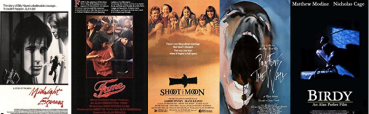
I watched a lot of Pink Floyd’s The Wall in 1987, and Alan Parker’s name on Angel Heart was really exciting at that time. I am not sure I understood Angel Heart at 15; but I do now and it remains one of my favorite.
Evil Dead II
I am sure that Spielberg’s Jaws, E.T. and Close Encounters laid their horror roots in my subconscious, but it was Sam Raimi’s Evil Dead II that brought them forth. I convinced my fellow 9th grade friends to see it with me opening weekend. Most of them hopped to another theater before the halfway point; I couldn’t believe what I had discovered.

Suddenly, the volume increases and the massive streams of gushing blood and bile shoot further and higher, splashing against the far wall, showering crew members…the gushing blood/bile quickly diminishes to several weak trickles. Director Sam Raimi crawls from beneath a sheet of plastic covering one of the cameras, sleeves rolled up, clothing soaked, heavy  rubber boots on his feet. He turns to the crew and smiles with charming, ingenuous, engaging innocence…”I think we had too much blood,” he says with calm, whimsical understatement, wading through the ankle deep blood flood.
Really, Fango. “Massive streams of gushing blood…wading through an ankle deep blood flood.” The images and words electrified my imagination and ignited an endless flame. This is all your fault.
Danny Hicks on Sam Raimi
He’s like a little kid, enjoying himself too much. He’s so funny. He keeps everything light. 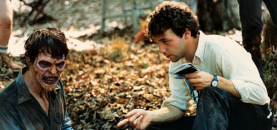 I’m having a hell of a good time…Sam is wonderful with actors. He’s one of those great directors. It’s never wrong, but it can always be better. He gets good work out of you through encouragement, rather than intimidation.
Hicks on Raimi mirrors Langenkamp on Craven. It is no coincidence that these two men continued to produce great work far into the future. I am especially fond of Raimi’s Spiderman, so much so that I used it teach high school kids about the language of film. The cage match, Spiderman’s first public introduction, is the perfect metaphor representing the transition to adulthood.
Sam Raimi on Evil Dead II
There’s no dissension among the leadership, no arguments. We just say OK, the unfinished shot is the enemy, let’s go for it…I would like to make a really thrilling story, a thrilling tale. The genre doesn’t matter to me. Something that grips people, a very powerful and dramatic story does.

While The Quick and the Dead seemed like a natural progression for Raimi’s experimental style, and A Simple Plan retained many horror elements, I was disappointed when For Love of the Game came out. Looking back on Raimi’s words now, I understand he was telling us that he would not be imprisoned by any one genre.
Sam Raimi on Evil Dead II Sequel
 Well, if the picture is good, yes. If it’s not good, no. That determination will be made by the audience. If they feel it’s good, they’ll let us know…I have a story and it should be very exciting.
Army of Darkness would be that “very exciting story.” Legendary.
Thanks for reading. Stay tuned for Flipping Through Fangoria #64.
Once I Took a Girl to Her First Rush Concert
Once, when I was 30, I took my girlfriend to see her first Rush concert. It was five years since the Test for Echo tour and nearly two years into our relationship. Things were solid; I found my passion in teaching, bought a house in a great neighborhood, and lost myself in what I knew was true love.
Fifteen minutes before Rush was set to hit the stage, I grew anxious. I felt overwhelmed. I led Maria from our seats and up the stairs to the front of the lawn. I had to make sure that she could see; I had to ensure that I could breath.
I wrapped my hands around her waist and rested my chin on her shoulder. I told her of the first time I’d heard Cinderella Man, of how Steve was so excited to record their albums onto cassette for me, of how Hemispheres, Farewell to Kings, Hold Your Fire, and Counterparts got me through the lonely college years, of how I missed the Counterparts tour traveling back and forth from Oregon, and of how Neil Peart lost his wife and daughter but somehow rode and wrote himself back to health.
The lights went out and the crowd roared; my breath escaped. Maria’s warmth embraced me. Rush hit the stage, the opening notes of Vapor Trails just exploding from Neil Peart’s drum kit. Seeing Rush return like this; and with Maria, feeling this with her, it was too much for me. I cried uncontrollably.
I cried for what I thought was lost; I cried for the journey Neil had taken; I cried for the strength I found in their music, and I cried because Rush existed. I still cry when I think of that moment, all these years later, but now I cry because I got to share it with the woman of my dreams.
Once I Fell Out of a Volkswagen Bus
Once, when I was 10, I fell out of a Volkswagen Minibus. We were squeezed in four across, Jim Schmucker at the wheel, Timmy and Kevin in the middle, and me tight against the metal door. As we left the dump and swung right and then left around the traffic circle, the passenger door flew open. Suddenly off balance, I grabbed the armrest with both hands and swung out with it. The front wheel spun just beneath my feet; I remember the blur of the pavement as Kevin reached for me. I can still see his face, panicked and frightened.
But I wouldn’t let go of the armrest; I couldn’t. I don’t know why Jim didn’t stop the bus. My fingers lost their grip and I fell, sliding on my back along the pavement. I tried to keep my head up, but it bounced off the street at least twice. In shock, scraped, and bloodied, I climbed back into the bus and sat silently as Jim took us back to the house. I don’t remember much after that. My parents picked me up later that night.
It was the last time I spent with Kevin and Timmy. Jim and Susan didn’t tell my parents what had happened, so when I showed them my cuts and bruises the next morning, they were understandably angry. I don’t know what my mother said to them; maybe I should have asked. But I was relieved, I think, to never have to go to their house again.
We Dream Our Sails
 In the depths of experience,
The recess of consciousness,
Pleasure and pain conjoin.
Flailing about this quest for survival,
Desperate we’re grounded.
In the confusion, balance is lost,
Swept amidst the turmoil of flesh and bone, blood and bile.
Peering down upon existence,
We dream our sails
And fly away.
Imagination Infinite
What if the lies are truth?
What if truth is myth?
What if myth is imagination?
What if imagination infinite?
What then?
What’s next?
 Darker Side of Film